Tired legs: massage or pressotherapy? An honest guide to choosing
Why legs get tired, what each treatment actually does and how to know which one suits you — with clear prices and no inflated promises.
Dra. Camila Guzmán · Medical Director at Clínica Cambria
9 min
The day ends and your legs feel like you walked twice as far. Your socks leave a mark on your ankles, your calves are tight and all you want is to put your feet up. If that sounds familiar, you are not alone: heavy legs are one of the most frequent reasons for consultation at our clinic in La Cañada, especially in summer and among people who spend long hours standing.
When you look for a solution, two names come up again and again: the tired-legs massage and pressotherapy. And the inevitable question: which one is better? In this guide we explain exactly what each one does, which profile it works for, what they cost and — because not everything is aesthetics — when the first step should be a medical consultation.
Why your legs get tired (and when it is not just tiredness)
Blood in your legs has to travel back to the heart against gravity. That venous return relies on the valves in your veins and on the natural pumping of your muscles as you walk. When you spend many hours standing or sitting, that pump slows down; heat also dilates the veins and the system loses efficiency. The result is accumulated fluid, swelling and that familiar feeling of heaviness.
Venous return, at a glance
Leg in motion
The muscle pump pushes blood upward
Still for hours
The pump slows down and fluid pools at the ankle
Some factors make it worse: summer, jobs on your feet (hospitality, healthcare, retail), a sedentary lifestyle, some contraceptives, pregnancy and genetics. That is why tired legs are not "cured" with a single session of anything: they are managed with consistency, habits and the right treatment for your specific case.
Signs that deserve a medical consultation before an aesthetic one
Most tired legs are a functional and aesthetic issue. But some signs require ruling out a vascular problem first:
- !Pain and swelling in one leg only, of recent onset
- !Bulging, painful varicose veins or skin colour changes
- !Swelling that does not go down after sleeping with your legs raised
- !Pain that increases when walking and forces you to stop
In any of these cases, the responsible thing is a medical assessment before booking any aesthetic treatment. At Cambria we will be the first to tell you.
What is going on with your legs? Three common profiles
In consultation, almost all tired legs fit one of these three profiles. Identifying yours is half the answer to the question "massage or pressotherapy?":
1Swelling and fluid retention
Drainage profile- Your socks leave a mark at the end of the day
- Heaviness clearly worsens with heat
- Legs feel "full" or tight rather than sore
Your priority is probably pressotherapy: mechanical, uniform, consistent drainage.
2Muscle tension and overload
Muscular profile- Calves feel hard or tender to the touch
- You work long hours standing or train frequently
- Heaviness feels like stiffness, not swelling
Your priority is probably massage: manual work that finds and releases tension points.
3A bit of everything, for a long time
Mixed profile- Heaviness and swelling coexist depending on the day
- You have been dragging it for months (or years)
- You have tried isolated things and nothing quite works
What usually works best is alternating both: pressotherapy as the drainage base and massage for tension.
Torn between two profiles? Your first assessment at Cambria is free and without obligation: we look at your legs and tell you honestly what makes sense — even if the answer is "nothing, for now".
The tired-legs massage: hands that find the exact spot
The circulatory and drainage massage for tired legs is manual work: our professional works through the muscles locating areas of tension and adapting the pressure in real time — something no machine can do. The overloaded calf, the soleus, the sole of the foot if needed, with upward strokes that support venous return.
It is the winning option when the main problem is muscular: legs that stiffen up, calves loaded from work or sport, specific painful spots. Beyond the circulatory effect, it has a genuine relaxation component that pressotherapy cannot match.
Pressotherapy: sequential drainage that never gets tired
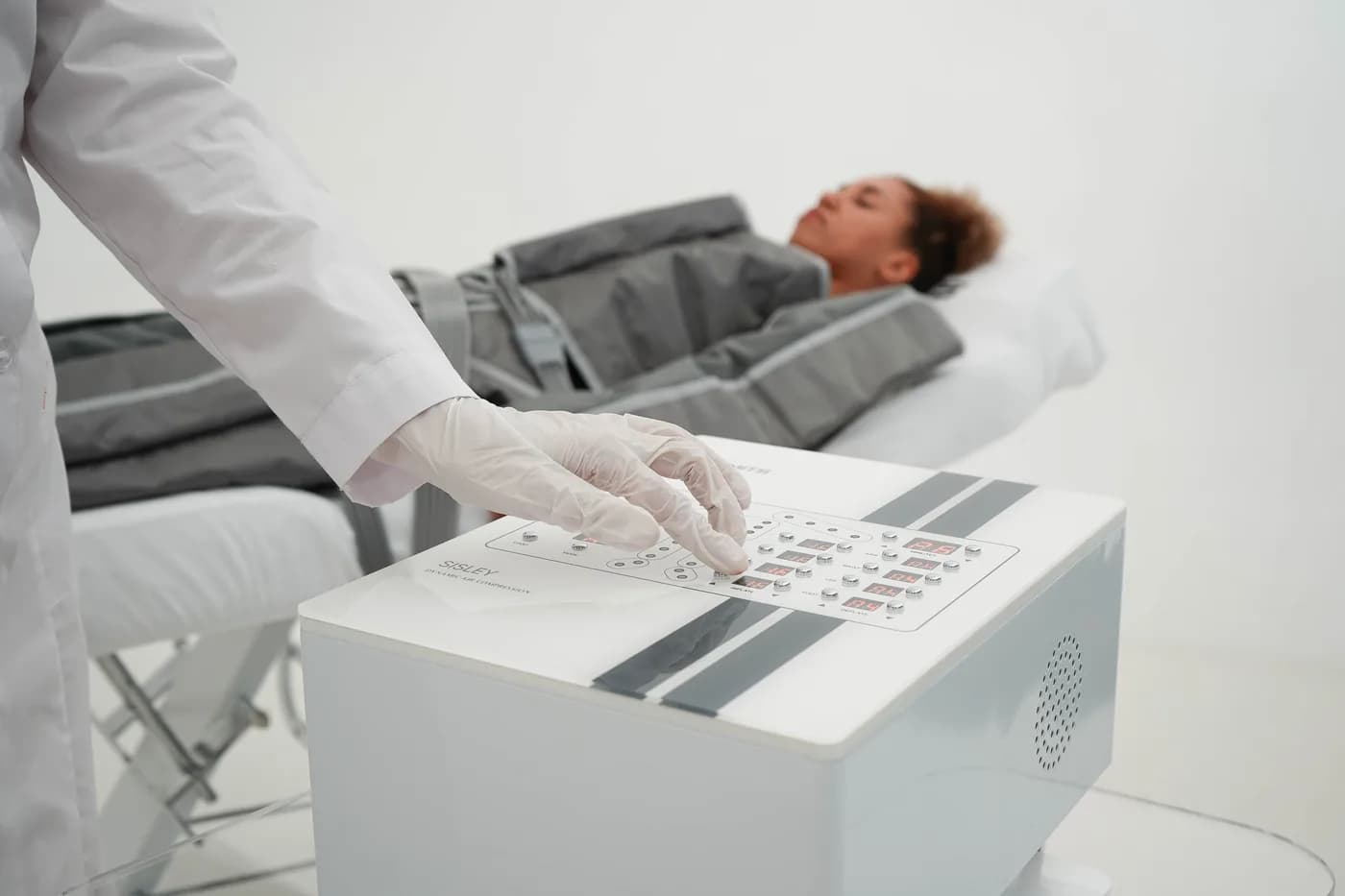
Pressotherapy uses pneumatic boots that wrap around your legs and apply cycles of compression and decompression through air chambers, always upward: from foot to thigh. It is, literally, a mechanical push for your venous and lymphatic system — the one your legs do not get when you spend the day still.
How the sequential compression advances
1 · Ankle
The lower chambers inflate first
2 · Calf
The pressure wave climbs, chamber by chamber
3 · Thigh
Fluid is pushed towards the lymphatic system
Its strength lies in consistency and uniformity: programmable pressure, identical in every session, impossible to replicate manually for 40 minutes. It is the winning option for fluid retention, swelling and diffuse heaviness. The feeling of lightness at the end is immediate, and the draining effect builds up over sessions — which is why it is offered in packs.
Pressotherapy for tired legs: prices and details →
Pregnant? Pressotherapy during pregnancy: when it is suitable and prices →
Massage vs pressotherapy, side by side
Neither is "better" in the abstract. They are different tools for different problems — this table sums up what really sets them apart:
| What we compare | Pressotherapy | Manual massage |
|---|---|---|
| How it works | Sequential, uniform air pressure over the venous and lymphatic system | Expert hands on muscle and tissue, adapting pressure in each area |
| Ideal for | Fluid retention, swelling, diffuse heaviness | Muscle tension, loaded calves, specific pain points |
| How it feels | Rhythmic, enveloping compression; many patients doze off | Variable pressure, from relaxing to intense depending on the area |
| Duration | 30-45 minutes | Depends on protocol and areas treated |
| Results | Immediate lightness; cumulative drainage with packs | Relief from the first session; cumulative effect on tension |
| Price | €20 per session · 5-pack: €75 · 10-pack: €145 | From €60 per session; closed quote at your free assessment |
Published, current prices at Clínica Cambria (La Cañada, Paterna). Your first assessment is always free.
What if the right answer is alternating them?
In the mixed profile — the most common among people who have had tired legs for a while — what works best in our experience is combining them: pressotherapy as a regular drainage base (weekly or fortnightly) and manual massage when muscle tension builds up. They do not compete: one works on fluid, the other on muscle.
And if you can only afford one, the choice goes back to your profile: retention → pressotherapy; tension → massage. At your free assessment we will tell you openly, without pushing you towards the more expensive one — in fact, the most common starting point is pressotherapy, which is also the most affordable.
When a patient tells me her legs feel heavy, the right question is not which treatment to offer her, but what is happening to her legs. Sometimes it is drainage, sometimes it is muscle, and sometimes the first step is ruling out a circulatory problem. That is why at Cambria the assessment always comes before the treatment.— Dra. Camila Guzmán · Medical Director at Clínica Cambria
Start by finding out what your legs need
Free, no-obligation assessment in La Cañada (Paterna), 15 minutes from central Valencia, with easy parking. We tell you which profile you have and what makes sense in your case — with clear prices before you start.
Pressotherapy for tired legs: prices and details →Tired-legs massage: how we work →
WhatsApp · +34 624 18 52 49Frequently asked questions about tired legs
Which is better for tired legs: massage or pressotherapy?
It depends on the cause. If fluid retention and swelling predominate, pressotherapy usually gives better results; if muscle tension predominates, manual massage. They are complementary and many patients alternate them. At Clínica Cambria's free assessment we recommend the best fit for your case.
How much does pressotherapy cost in Valencia?
At Clínica Cambria (La Cañada, Paterna) a single session costs €20, the 5-session pack €75 (€15 per session) and the 10-session pack €145 (€14.50 per session). Your first assessment is free and prices are published on our website.
How many sessions do I need to feel my legs lighter?
The feeling of lightness is immediate from the first session. For sustained results on fluid retention we recommend 8-10 sessions (2-3 per week) followed by maintenance of 1 session per month — or weekly if you spend long hours standing.
Can I do pressotherapy if I have varicose veins?
With mild varicose veins yes, and it usually relieves symptoms. With bulging veins, a history of thrombosis or skin changes, a prior medical assessment is essential. If we detect warning signs, we will tell you before treating.
Does pressotherapy make you lose weight?
It is not a weight-loss treatment and we do not sell it as one. It reduces volume caused by fluid retention and improves leg contour, which is different. For localised fat there are other options, such as body mesotherapy, which we assess separately.
Can I have these treatments while pregnant?
Pregnancy puts a heavy load on the legs, but each case must be assessed individually and by trimester. We offer a specific prenatal massage performed by trained professionals; pressotherapy during pregnancy is only considered under medical criteria. Ask us before booking.
Reviewed by
Dra. Camila Guzmán
Medical Director · Clínica Cambria, La Cañada (Paterna, Valencia)
This article is for information purposes and does not replace an individual medical assessment. If you have any of the warning signs described, consult a medical professional before undergoing any aesthetic treatment.