Hair loss: when to worry and what really works
How much shedding is normal, which signs deserve attention, what causes lie behind it and which treatments work — mesotherapy, PRP, hair dermapen — explained honestly, with AI-supported diagnosis.
Dr. Camila Guzmán · Medical Director
10 min
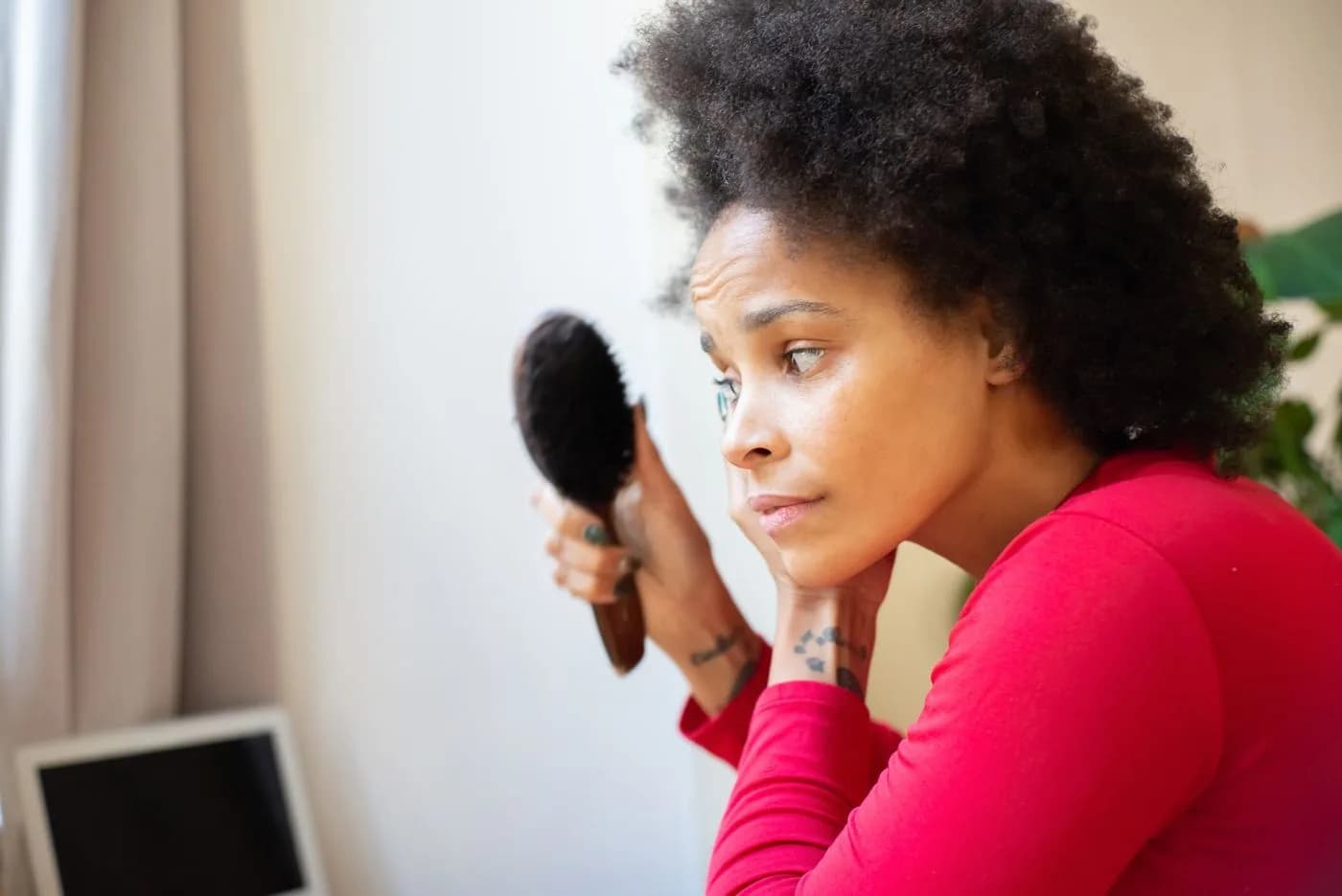
The scare is always similar: the brush with more hair than usual, the shower drain, the ponytail that feels thinner. And the first question too: is this normal or is something happening? The short answer is that losing between 50 and 100 hairs a day is completely physiological — the long one is that there are specific signs that do distinguish normal shedding from one that deserves attention.
In this guide we explain what those signs are, what causes usually lie behind them, how we perform the hair diagnosis with the support of artificial intelligence, and which treatments make sense in each case — including the ones we don't offer ourselves, because an honest guide shows you the complete map.
How much shedding is normal (and the signs that are not)
Hair lives in cycles: each follicle grows for years (anagen phase), rests for a few weeks and releases the hair (telogen phase) to start again. On a healthy scalp, around 85-90 % of follicles are growing and the rest shedding — hence those 50-100 daily hairs you see on the brush that mean nothing bad. There is even seasonal shedding, typical of autumn, that resolves on its own.
The signs that do deserve an assessment are different:
- Clearly heavier shedding than usual for more than 2-3 months
- Your parting looks wider than before
- The ponytail has less body, hair has lost density
- A receding hairline or thinning crown
- Scalp increasingly visible under direct light
- Hair falling in clumps or bald patches — in this case, dermatologist directly
The 4 most frequent causes
Treating hair loss without knowing the cause is throwing money away. These are the ones we see most in consultation:
Telogen effluvium
Reactive sheddingDiffuse, striking shedding that appears 2-3 months after a trigger: intense stress, postpartum, restrictive diets, surgery or fever. The good news: once the cause is identified, it is usually reversible — the follicle doesn't die, it has just 'synchronised' to shed.
Androgenetic alopecia
The most commonGenetic and hormonal, progressive, and not exclusive to men: in women it shows as diffuse density loss with an ever-wider parting. The earlier you act, the more follicle there is left to preserve — here, time really matters.
Deficiencies and internal causes
What blood tests revealLow iron and ferritin, vitamin D deficiency, thyroid disorders or hormonal changes can be behind persistent shedding. That is why a serious assessment includes reviewing or requesting blood tests before treating anything.
Alopecias that need a dermatologist
Direct referralAlopecia areata (bald patches), scarring alopecias or any hair loss with itching, pain or significant scalp flaking need dermatological diagnosis. If that is your case, we refer you immediately: it is our rule.
Hair diagnosis with data, not by eye
Our hair assessment combines three layers: your history (triggers, family background, medication, blood tests), the analysis of the scalp and density with the support of artificial intelligence — the same mapping technology we use in the facial diagnosis —, and the medical judgement that puts all the pieces together. The result is an objective starting point: we know where we begin and can measure progress at follow-up, not just 'see' it.
The first hair assessment is free and carries no obligation — and if your case needs a dermatologist or blood tests, we will tell you that very day. Book your assessment →
What works: the treatment ladder
With the cause identified, these are the real options — from the base to the reinforcement, and combinable with each other:
1The base: correcting the cause and habits
Nothing works without thisFor every case, always.
Correcting deficiencies (iron, vitamin D), taking care of nutrition and rest, and treating the scalp with respect: fewer thermal and chemical aggressions, no constant traction hairstyles. If there is an effluvium, removing the trigger is 80 % of the treatment.
2Hair mesotherapy
Nutrition straight to the follicleFor weakened density, prolonged effluvium and as the base of almost every protocol.
Microinjections of vitamins, amino acids and revitalising actives directly into the scalp, where the follicle needs them. Quick sessions, minimal discomfort and no downtime. Results are built with the full protocol, respecting the hair cycle.
3Hair PRP
Your own growth factorsFor early-moderate androgenetic alopecia and density loss, as a biological reinforcement.
We draw a small sample of your blood, concentrate the platelets and infiltrate them into the scalp: their growth factors stimulate the follicle. Evidence as an adjuvant is growing and the best results come from combining it — it is not an isolated miracle, and that is how we will present it.
4Hair dermapen
The enhancerTo stimulate the follicle and multiply the absorption of actives.
Scalp microneedling that creates microchannels: it stimulates local microcirculation and helps mesotherapy or PRP actives penetrate better. It joins the protocol when your case calls for it.
5Pharmacological treatment
The medical-dermatological routeFor established androgenetic alopecia.
Drugs such as minoxidil or antiandrogens have solid evidence and are prescribed under medical supervision. Our treatments complement them, they do not replace them — and if your case needs them, we will point you to that consultation just as clearly.
4 hair myths worth retiring
✗"Washing your hair often increases hair loss."
✓Washing only releases hairs that were already loose in their shedding phase. A clean scalp is better ground for the follicle than one with accumulated sebum and residue.
✗"Anti-hair-loss shampoo solves alopecia."
✓Shampoo is in contact with the scalp for a couple of minutes and is rinsed off: it can improve the terrain, but no shampoo reverses alopecia. Beware of the promises on the bottle.
✗"Cutting your hair makes it grow stronger."
✓Cutting affects the shaft, which is lifeless matter — the follicle, which decides thickness and cycle, doesn't even notice. Short hair only looks thicker.
✗"My hair falls out in autumn: I have alopecia."
✓Autumn seasonal shedding is a physiological, transient phenomenon that resolves itself in a few weeks. The difference from alopecia is duration and real density loss — exactly what the diagnosis evaluates.
In hair health, the classic mistake is starting with the treatment instead of the cause: months of products for a shedding that was asking for an iron blood test. First the why, then the what — and with the follicle, the sooner the better.— Dr. Camila Guzmán, Medical Director of Clínica Cambria
Is your hair sending signals?
At Clínica Cambria (La Cañada, Paterna) the hair assessment is free: we analyse your scalp and density with the support of artificial intelligence, review your history and give you an honest plan — even if that means referring you to a dermatologist or requesting blood tests before treating.
WhatsApp · +34 624 18 52 49Frequently asked questions about hair loss
How many hairs a day is it normal to lose?
Between 50 and 100 hairs a day is completely physiological: they are follicles finishing their cycle and starting again. The number looks scary on the brush or in the shower, but what matters is not one day's count, it is the sustained trend and the loss of density.
Is autumn shedding a cause for concern?
Usually not: it is physiological seasonal shedding that lasts a few weeks and recovers on its own. If it lasts longer than 2-3 months or you notice real density loss (wider parting, thinner ponytail), then it does deserve an assessment.
My hair is falling out a lot after childbirth — is that normal?
Yes, it is postpartum telogen effluvium: pregnancy hormones 'retain' hair that is then released all at once, typically 2-4 months after delivery. It usually resolves itself within months; if it drags on or worries you, hair mesotherapy can support the recovery.
Does hair PRP really work?
Evidence as an adjuvant in early-moderate androgenetic alopecia is growing, and in our experience it improves density and thickness in well-selected patients — but it is not an isolated miracle nor a replacement for pharmacological treatment when indicated. We will always give you a realistic expectation.
How long until I see improvement?
Hair moves at its own pace: the follicular cycle means any treatment needs 3-4 months to show visible results, with progressive improvement up to 6-12 months. That is why we measure the starting point with data — so progress can be seen, not guessed.
Is hair loss in women treated the same as in men?
The foundation is common, but in women internal causes (iron, thyroid, hormonal changes) weigh more and androgenetic alopecia presents differently (diffuse density loss). That is why the female assessment puts special focus on clinical history and blood tests.
When should I go straight to a dermatologist?
With hair falling in clumps, bald patches, itching, pain or significant scalp flaking, or any sign of scarring alopecia. In those cases the dermatological diagnosis comes first — and if we see you first, we will refer you immediately.
Article reviewed by
Dr. Camila Guzmán
Medical Director of Clínica Cambria · Licensed physician nº 03-0314801
This article is for informational purposes, has been reviewed by the Clínica Cambria medical team, and in no case replaces an individual medical assessment.