Men's skincare: why it matters and where to start
Men's skin is oilier, gets shaved almost every day and often sees the sun unprotected. What makes it different, what ages it faster and the minimal routine that works, explained by the Cambria medical team.
Dr. Camila Guzmán · Medical Director
8 min
November is Movember, the movement that uses the moustache to talk about men's health. It's a good moment for a topic many men still leave to luck: their skin. Plenty of them stop at shower gel and shaving foam, and not out of indifference. For years nobody told them their skin has needs of its own.
Men's skin is not the same as women's, it meets a razor almost every day and it usually spends years in the sun without protection. None of that is fixed by a miracle product, but a short, well-chosen routine does the job. In this guide we explain what makes it different, what ages it faster and where to start.
Unprotected sun ages skin faster than the years do
Ultraviolet radiation is the main accelerator of visible skin ageing. In a study of almost 300 women aged 30 to 78, the authors estimated that UV exposure accounts for up to 80% of visible signs of facial ageing: spots, wrinkles and loss of texture.[1] There is no reason to think men's skin escapes that effect. Solar radiation is also classified as carcinogenic to humans: it causes melanoma and other skin cancers.[2]
The good news is that it can be prevented. In an Australian clinical trial with 903 adults under 55, those who used sunscreen daily for four and a half years showed no detectable increase in skin ageing. In the group that used it only when they felt like it, the odds of more ageing were 24% higher.[3] A broad-spectrum sunscreen every morning, winter included, is the single highest-impact step in the routine.
Frequent shaving irritates the skin and can leave dark marks
Running a blade over the face almost daily without preparing or moisturising the skin causes nicks, burning and folliculitis. In men with curly beards or coarse hair there is also pseudofolliculitis barbae: the freshly cut hair grows back into the skin, gets inflamed and leaves bumps that, as they heal, can leave post-inflammatory hyperpigmentation.[4] Those are the dark marks on the neck and jawline that never quite fade.
Simple changes that reduce irritation:
- Shave after showering, with skin and hair damp and softened.
- Use gel or foam and shave in the direction of hair growth.
- Change the blade often: a dull blade tugs at the hair and cuts badly.
- Afterwards, an alcohol-free soothing cream or balm instead of a lotion that stings.
- If the bumps and marks on your neck don't settle, get them checked: laser hair removal of the area is one of the options that reduces them most.[4]
Men's skin produces more oil
Androgen hormones, testosterone first among them, stimulate the sebaceous glands. That is why reviews comparing men's and women's skin generally find more sebum, more thickness and more hydration in male skin.[5] More oil means more shine, enlarged pores, blackheads and breakouts, which for many men don't end with adolescence.
The answer is not to scrub harder or use harsh, drying products, because the skin responds by producing even more oil. A gentle cleanser twice a day and a light, oil-free moisturiser work better. If acne or scarring persists, get a medical assessment before trying treatments on your own.
Skin doesn't look after itself, and time shows
Over the years skin gradually loses collagen. The classic studies on skin thickness and collagen show that decline with age in both sexes, and men's skin starts with more collagen, so the change usually shows later.[6] But it shows: fine lines, deeper dark circles, a sagging jawline and duller skin.
Add years of unprotected sun and the wear builds up. A basic routine won't stop the clock, but it keeps skin firmer and better-looking for longer, and any later treatment starts from a better base.
The minimal routine: three steps, five minutes
You don't need a cupboard full of products. This is the base we recommend to almost any man starting out:
1Cleanse
Morning and night- A gentle facial cleanser, not shower gel or hand soap.
- Lukewarm water, never very hot, and pat dry.
- Oily skin: choose a gel cleanser. Dry skin: a cream one.
Removes the day's oil and dirt without damaging the skin barrier.
2Moisturise
Morning and night- A light moisturiser that doesn't leave shine. It can replace aftershave.
- At night, the same one or a slightly richer one if your skin feels tight.
- If you shave, apply it right afterwards: it soothes and reduces irritation.
Well-moisturised skin gets less irritated by shaving and holds up better over time.
3Protect
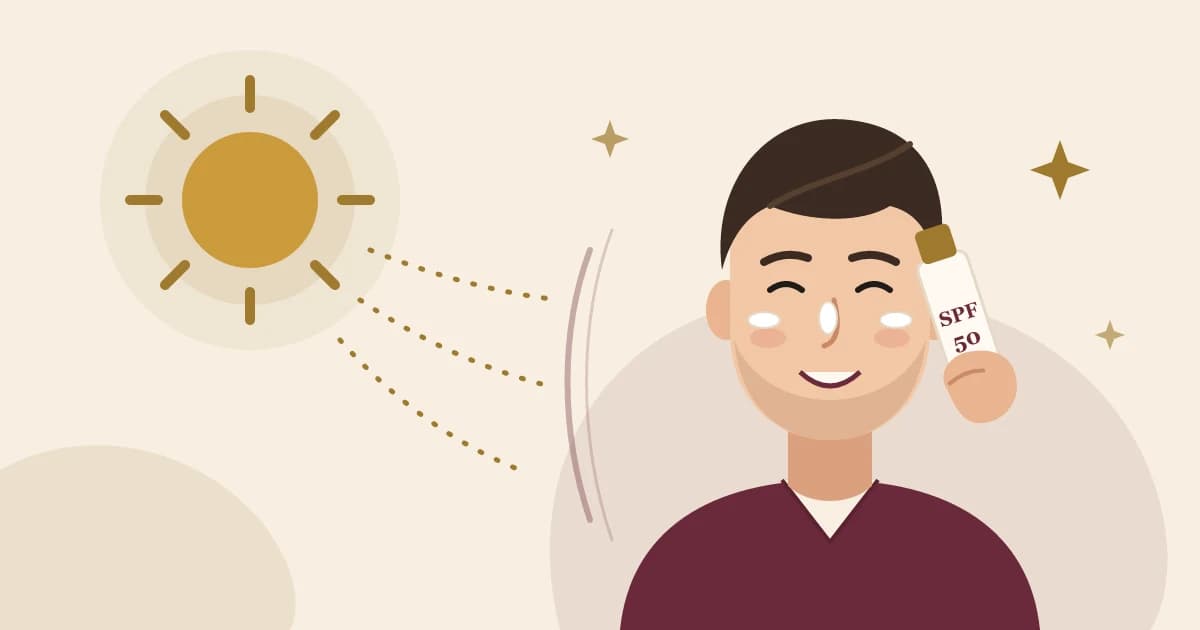
Every morning- Broad-spectrum sunscreen, SPF 50 or higher.
- All year round, on cloudy days and in winter too.
- There are fluid and gel textures that leave no white cast or shine.
The step with the strongest evidence for preventing spots and wrinkles, and it shields you from the radiation that causes skin cancer.[1][2][3]
Once the basic routine is a habit, you can add specific actives, such as niacinamide for oiliness or retinoids for ageing. It's better to do it with a diagnosis of your skin than by trying products at random.
When it's worth booking a visit
The home routine is the foundation. In some situations, an in-clinic treatment speeds results up a lot:
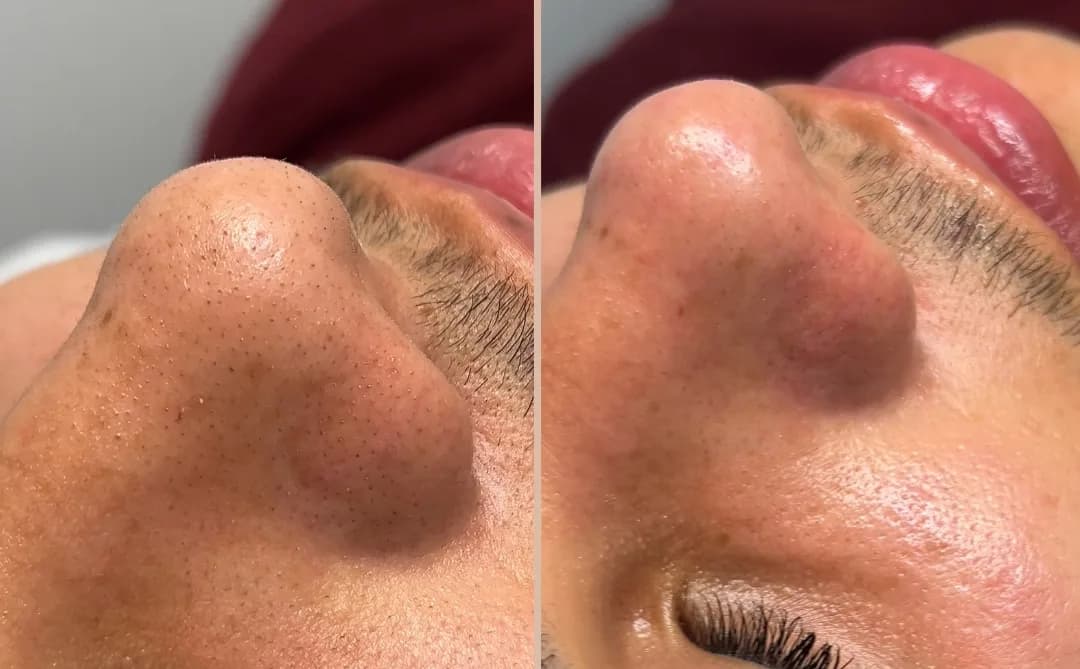
Enlarged pores and blackheads that don't improve
A deep facial cleanse (from €60) clears pores with professional extraction and gets the skin ready for your routine.
Dark spots, acne marks or dull tone
A medical chemical peel renews the surface layers and evens out tone, with a protocol adapted to your skin.
Irritation and bumps from shaving
Laser hair removal on the most problematic areas, such as the neck, reduces hairs growing back in.[4] From €15 per session for the neck.
You don't know what your skin needs
The AI facial diagnosis measures oil, pores, spots and wrinkles zone by zone, and you leave with a personalised routine. It's free.
!If you have a mole or spot that changes shape, size or colour, bleeds or looks different from the rest, see a doctor or dermatologist without waiting. That is not a cosmetic issue.
Worried about hair loss too? Read our guide to causes and solutions →
Many men come to the clinic for the first time after 40, when spots or sagging already show. Looking after yourself isn't a gender thing. Cleanse, moisturise and protect from the sun every day, and in ten years your skin will thank you.— Dr. Camila Guzmán, Medical Director of Clínica Cambria
Start by knowing what your skin needs
At Clínica Cambria (La Cañada, Paterna, 15 minutes from Valencia) we analyse your skin with artificial intelligence and medical judgement and give you a routine designed for you, with a fixed quote if you need any treatment. Free and with no commitment.
Book your AI facial diagnosis →Discover our deep facial cleanse →Laser hair removal: prices by area →
WhatsApp · +34 624 18 52 49Frequently asked questions
Do men need a different facial routine from women?
The base is the same: cleanse, moisturise and protect from the sun. What changes is the choice of products. Men's skin usually produces more oil, so gel cleansers and light moisturisers tend to work better. Shaving also means looking after irritation with soothing products.[5]
Can I wash my face with shower gel?
It's not ideal. Body washes are usually harsher and can dry out and irritate facial skin, which is thinner. A gentle facial cleanser costs little and you notice the difference within a few weeks.
Do I need sunscreen in winter?
Yes. The ultraviolet radiation that ages skin is present all year, including on cloudy days. In a clinical trial, daily sunscreen use slowed visible skin ageing compared with occasional use.[3]
How do I avoid bumps and marks after shaving?
Shave with damp skin, with the grain and with a blade in good condition, then apply an alcohol-free soothing cream. If the bumps are constant or leave marks, laser hair removal of the area and a medical assessment are usually the most effective solution.[4]
At what age should a man start looking after his skin?
The sooner the better. Cleansing and sun protection make sense from adolescence, and daily moisturising from your 20s. It's never too late to start: skin responds to care at any age.
Which facial treatment is best for a man who's starting out?
It depends on your skin. For oily skin with enlarged pores, a deep facial cleanse is usually the first step. For spots or acne marks, a medical peel. To decide with proper criteria, at Cambria we start with a free AI facial diagnosis.
Sources
- [1]Flament F, Bazin R, Laquieze S, et al. «Effect of the sun on visible clinical signs of aging in Caucasian skin». Clinical, Cosmetic and Investigational Dermatology, 2013;6:221–232. doi.org/10.2147/CCID.S44686
- [2]IARC Working Group on the Evaluation of Carcinogenic Risks to Humans. «Solar and Ultraviolet Radiation». IARC Monographs on the Evaluation of Carcinogenic Risks to Humans, vol. 55. Lyon: International Agency for Research on Cancer, 1992. publications.iarc.who.int/73
- [3]Hughes MCB, Williams GM, Baker P, Green AC. «Sunscreen and prevention of skin aging: a randomized trial». Annals of Internal Medicine, 2013;158(11):781–790. doi.org/10.7326/0003-4819-158-11-201306040-00002
- [4]Ogunbiyi A. «Pseudofolliculitis barbae; current treatment options». Clinical, Cosmetic and Investigational Dermatology, 2019;12:241–247. doi.org/10.2147/CCID.S149250
- [5]Rahrovan S, Fanian F, Mehryan P, et al. «Male versus female skin: What dermatologists and cosmeticians should know». International Journal of Women's Dermatology, 2018;4(3):122–130. doi.org/10.1016/j.ijwd.2018.03.002
- [6]Shuster S, Black MM, McVitie E. «The influence of age and sex on skin thickness, skin collagen and density». British Journal of Dermatology, 1975;93(6):639–643. doi.org/10.1111/j.1365-2133.1975.tb05113.x

Article reviewed by
Dr. Camila Guzmán
Medical Director of Clínica Cambria · Registered physician no. 03-0314801
This article is for informational purposes only, has been reviewed by the Clínica Cambria medical team and does not replace an individual medical assessment.