Pelvic Floor After Childbirth: An Honest Recovery Guide
What happens to your pelvic floor during pregnancy and childbirth, which signs you should never normalize, and which real options exist — explained without alarmism or empty promises by the medical team at Clínica Cambria.
Dr. Camila Guzmán · Medical Director
9 min

If you recently became a mother and notice urine leaks when laughing or sneezing, a feeling of heaviness in your lower abdomen, or discomfort during intimacy, the first thing we want to tell you is this: it is very common, you are not alone and — above all — it can be treated.
The pelvic floor is the set of muscles and ligaments that supports the bladder, uterus and rectum. During pregnancy it carries a growing weight for months, and during childbirth it stretches to extraordinary limits. Needing recovery afterwards is not a weakness: it is pure biology.
Studies estimate that around one in three women experiences urine leaks postpartum. And yet most never seek help: they accept it as the price of motherhood. This guide exists to tell you, with medical honesty, which signs to watch, which options exist and in which order it makes sense to consider them.
What the pelvic floor is (and why you notice it now)
Imagine a muscular hammock woven between the pubic bone and the sacrum. Your bladder, uterus and rectum rest on it. That hammock does four jobs at once: it supports your organs, controls continence (urine and gas), participates in sexual function and stabilizes your posture together with the deep core.
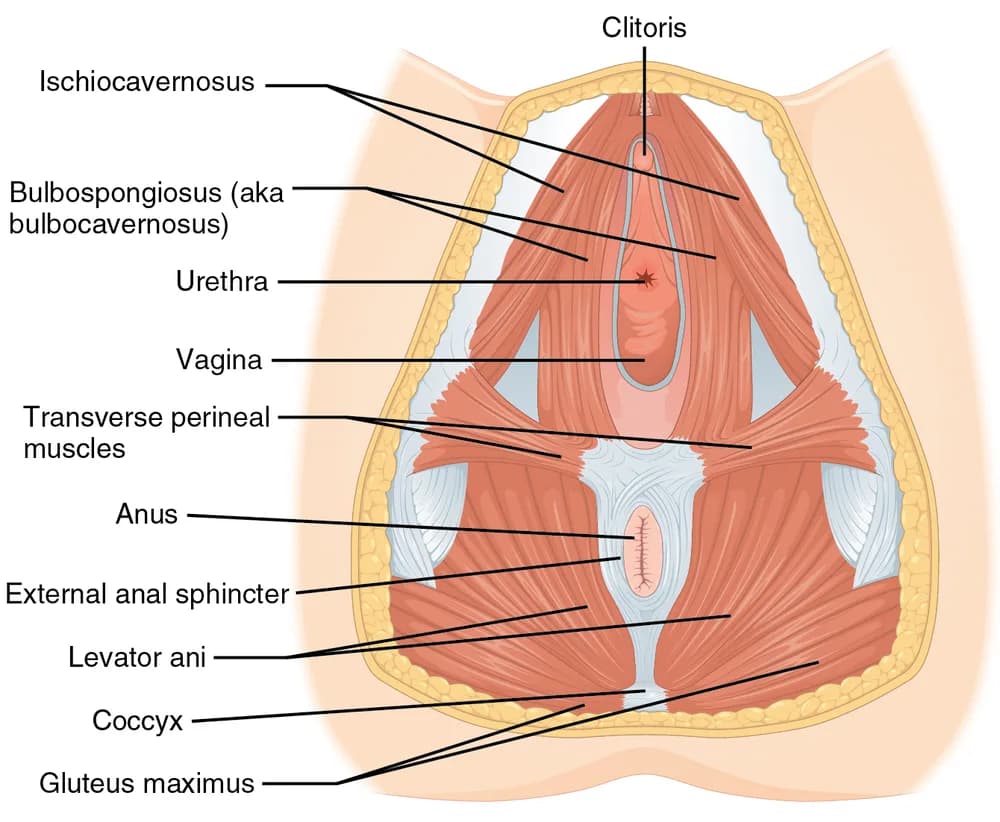
During pregnancy, the hammock carries more weight every week while hormones (relaxin, progesterone) deliberately loosen its tissues to prepare for birth. In a vaginal delivery, those muscles stretch up to three times their length. And a C-section does not spare you the process: nine months of load have already done their part.
The result for many women is tissue with less tone and less collagen than before. Sometimes it recovers on its own within weeks. Sometimes it needs help. The difference between the two is called professional assessment.
8 signs your pelvic floor is asking for attention
None of these signs is "just what happens after having a baby". Common, yes; normal, no. If you recognize yourself in one or more, it deserves an assessment:
- Urine leaks when coughing, laughing, sneezing or exercising
- Sudden urges to urinate that are hard to hold
- A feeling of heaviness or a "bulge" in the vagina, especially at the end of the day
- Discomfort or reduced sensitivity during intercourse
- A feeling of vaginal looseness or laxity
- Difficulty holding in gas
- Persistent lower back or pelvic pain with no clear cause
- Intimate dryness you did not have before
⚠ If you also notice a visible bulge at the vaginal opening, intense pain or stool leakage, do not wait: book directly with your gynaecologist or a pelvic floor unit.
The golden rule: assessment first, treatment second
The internet is full of one-size-fits-all Kegel routines. Clinical reality is more nuanced: some pelvic floors are weak and need strengthening, but others are hypertonic (too tense) and doing hundreds of Kegels makes things worse. Without an assessment, you cannot know which group you are in.
Weak, balanced or hypertonic: they are not the same
Weak (hypotonic)
Needs strengthening
Balanced tone
The goal to maintain
Hypertonic (tight)
Needs to relax, not more Kegels
That is why the first step after the postpartum period and check-up is a specific assessment: with your midwife, a pelvic floor physiotherapist, or a medical consultation with objective evaluation tools. From there, the options fall into place naturally.
The real options, explained honestly
There is no single solution: there is a ladder of options, and the honest approach is to climb it in order. Here is what works, for whom, and what to expect from each step.
1Pelvic floor physiotherapy
The foundationFor virtually all women after childbirth.
It is the first-line treatment with the most evidence. A specialized physiotherapist assesses your muscle tone and designs a personalized program: properly executed Kegels, hypopressives, biofeedback or electrostimulation depending on your case. Improvement is usually noticeable within 2-4 months of consistent work.
2Habits that protect (or harm) your pelvic floor
The multiplierFor everyone, alongside any treatment.
Avoiding constipation (daily straining means micro-trauma), postponing high-impact sports until you have professional clearance, replacing classic crunches with deep core work, and distributing loads (the baby bag counts too). Small habits with a huge cumulative effect.
3Non-invasive technology: intimate HIFU
The reinforcement, when indicatedFor women with vaginal laxity, dryness or mild stress leaks that persist after initial recovery, who do not want or need surgery.
Focused ultrasound stimulates collagen regeneration in the vaginal mucosa and contributes to tissue tone, without surgery or downtime. At Clínica Cambria we apply it with a particularity that matters to us: an objective laxity measurement by pneumatic pressure before and after, so improvement shows in data and not just sensations. It is not for everyone — and if it is not your case, we will tell you at the first consultation.
4Advanced gynaecological or urological evaluation
When the case requires itFor moderate or severe incontinence, symptomatic prolapse or persistent pain.
Some cases need a urogynaecological workup and, sometimes, surgery. Detecting them early is key, and no aesthetic treatment should delay that consultation. A good aesthetic medicine professional knows when a patient is not theirs: that is our policy.
5 myths worth retiring
✗"Leaking after having a baby is normal; you just accept it."
✓It is common, not normal. Mild postpartum incontinence has effective treatments, and the earlier it is addressed, the better it responds.
✗"Kegel exercises are good for everyone."
✓Only if your pelvic floor needs strengthening. In hypertonic pelvic floors they can worsen symptoms. Assess first, exercise second.
✗"I had a C-section, so my pelvic floor is intact."
✓Pregnancy itself — nine months of weight and hormonal changes — already overloads the pelvic floor. A C-section reduces part of the risk; it does not eliminate it.
✗"Classic ab crunches will help me recover the area faster."
✓Crunches increase intra-abdominal pressure and push down exactly what you are trying to support. The right work is deep core and hypopressives, with professional guidance.
✗"Years have passed since my delivery; it's too late for me."
✓Tissue responds to the right stimuli at any age. It is never too late for an assessment — including during and after perimenopause.
A realistic timeline
Every body has its own pace, but this is the order we recommend as a reference:
- 1
Weeks 0-6
Postpartum rest: no unnecessary loads and no high-impact exercise. Your body is completing its own process.
- 2
Weeks 6-8
Postpartum check-up with your midwife or gynaecologist. This is the moment to mention any sign from the list above — all of them, including the embarrassing ones.
- 3
Months 2-4
Specific pelvic floor assessment and, if appropriate, personalized physiotherapy. Progressive return to exercise with guidance.
- 4
Months 4-6
Reassessment. If laxity, dryness or mild leaks persist despite the foundation work, it is time to consider reinforcements such as intimate HIFU — with a prior objective measurement.
- 5
Onwards
Maintenance: the pelvic floor is trained for life, like any other muscle group you care about.
In intimate health, the phrase we hear most in consultation is: 'I thought it was normal.' It is not. And the second: 'I wish I had come sooner.' A consultation commits you to nothing — it gives you information about your own body, which is the basis of any good decision.— Dr. Camila Guzmán, Medical Director of Clínica Cambria
Did you recognize yourself in this guide?
At Clínica Cambria (La Cañada, Paterna) we offer a free, private intimate health consultation, always carried out by female physicians, including an objective laxity assessment. You leave with clear information about your case and — only if it makes sense for you — a plan with a fixed quote.
Learn about our non-surgical intimate rejuvenation treatment →
WhatsApp · +34 624 18 52 49Frequently asked questions
When can I start treating my pelvic floor after childbirth?
The assessment can be done from the postpartum check-up (6-8 weeks). Active treatment — physiotherapy, and later technology if appropriate — starts afterwards, always with clearance from your midwife or gynaecologist.
Do urine leaks go away on their own with time?
They sometimes improve spontaneously in the first months, especially very mild ones. But if they persist beyond 3-6 months after delivery, they are unlikely to disappear without treatment — and they respond much better the earlier they are addressed.
Does intimate HIFU replace pelvic floor physiotherapy?
No. Physiotherapy is the foundation with the most evidence, and HIFU is a complement for the tissue (collagen, mucosa, tone) in selected cases. That is how we present it at our consultation — and if you only need physiotherapy, we will tell you.
Can I get an assessment if I gave birth years ago?
Yes. Laxity, dryness or mild leaks can appear or persist years after childbirth, and also with menopause. An assessment with objective measurement makes sense at any time.
Who sees me at Clínica Cambria's intimate health consultation?
Always a licensed female physician from our team, in a private consultation with complete confidentiality. The first visit is free, includes the objective laxity measurement and implies no commitment.
Does this article replace a medical consultation?
No. It is an informational guide. Every case needs an individual assessment: if you have symptoms, consult your midwife, your gynaecologist or our medical team.

Article reviewed by
Dr. Camila Guzmán
Medical Director of Clínica Cambria · Licensed physician nº 03-0314801
This article is for informational purposes, has been reviewed by the Clínica Cambria medical team, and in no case replaces an individual medical assessment.